
Kotor Sea Gate
Start your Old Town visit at the Sea Gate — Kotor's main western gate of 1555, opening from the waterfront onto Arms Square and the leaning clock tower. Where to find it from the cruise port, what to look for, and how to plan a route through the squares.

Photo: Fatih Beki / Unsplash
- ✓The Sea Gate (Vrata od mora) is Kotor's main entrance — the grand western portal of 1555 that opens straight onto Arms Square.
- ✓It sits on the waterfront just inside the walls, a few minutes' walk from the cruise berth and the marina — for most visitors, this is where the Old Town begins.
- ✓Above the gate, look for the relief of the Madonna and Child flanked by St Tryphon and St Bernard, and a Tito-era inscription on the inner wall.
- ✓Step through and you face Arms Square and the leaning Venetian clock tower — the natural meeting point and orientation hub of the Old Town.
- ✓The gate is open and free to pass through at all hours; the squares beyond are busiest mid-morning on cruise days.
- ✓Use the gate as the start of a square-to-square walk: Arms Square, then on toward Flour Square and St Tryphon's.
Where the Old Town begins
For almost everyone arriving in Kotor, the visit begins at the Sea Gate — Vrata od mora, the Gate of the Sea. It is the grandest and busiest of the Old Town's three main gates, set in the western wall that faces the bay, and it is the one you reach first whether you come off a cruise tender, walk in from the marina, or cross from the bus station and car parks just outside. Pass beneath its stone arch and the noise and traffic of the waterfront fall away into the hush of car-free lanes.
The gate dates to 1555, built under Venetian rule when Kotor's defences were being reinforced against the Ottoman threat, and it has been the town's front door ever since. It is not a delicate thing — it is a broad, fortified passage cut through walls metres thick — but the details above and around it reward a moment's pause before you are swept inside by the crowd. This is the threshold between the bay and the maze, and it is worth crossing slowly the first time.
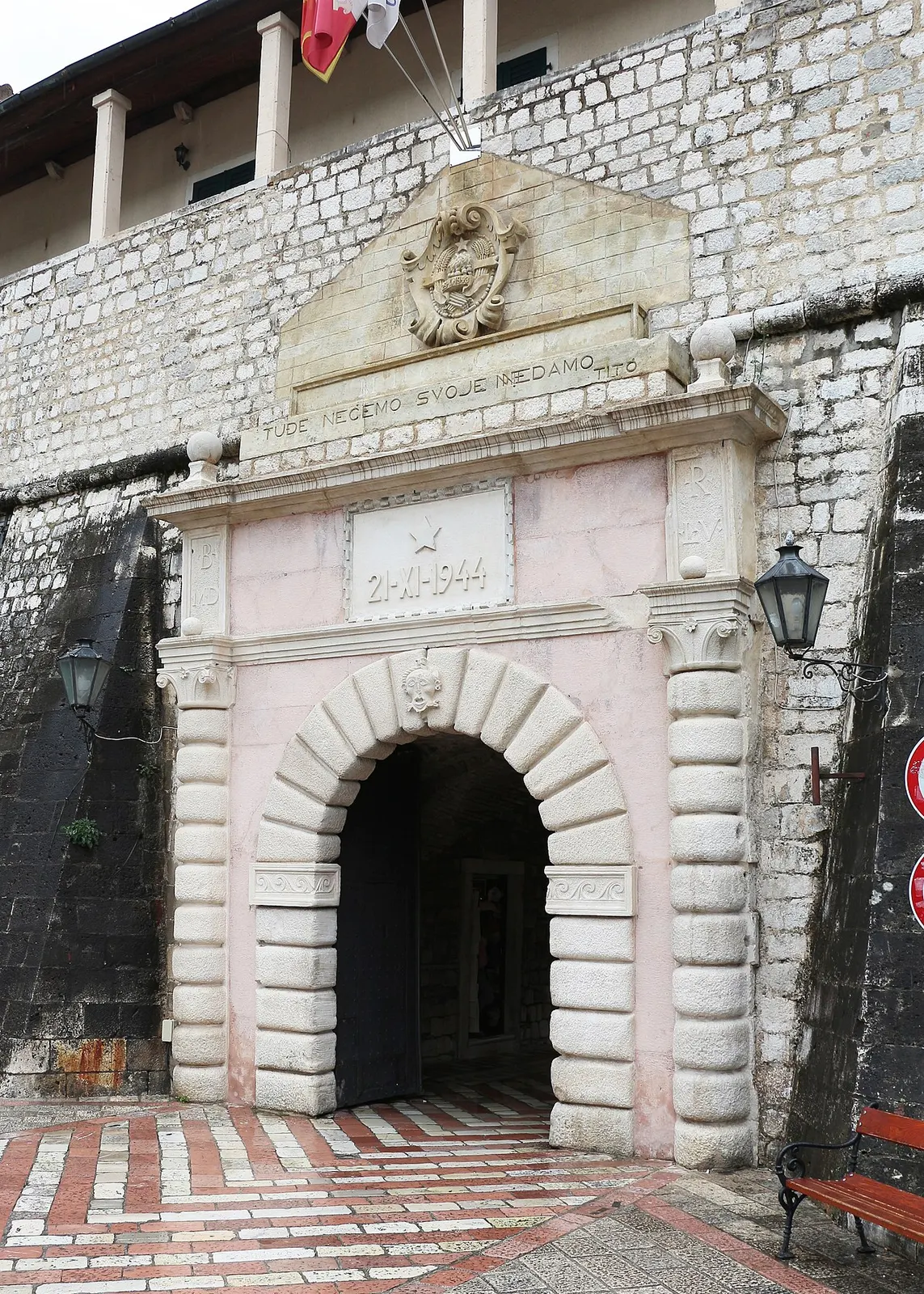
What to look for at the gate
Before you step through, look up. Above the outer arch sits a stone relief of the Madonna and Child, flanked by St Tryphon — Kotor's patron — and St Bernard, a quiet statement of whose protection the town claimed. The gateway itself is layered with history: the lower stonework is older than the 1555 facade, and the whole structure has been patched and re-faced over the centuries the way a much-used door always is.
Pass inside and turn to look back at the inner wall, where a 20th-century inscription marks the date of the town's liberation in the Second World War — a Socialist-era addition that sits, a little incongruously, among the Venetian stone. It is a small reminder that Kotor's walls have framed many different histories. Just inside, set into the wall, a relief and shrine to the Madonna often gathers fresh flowers. Take it all in here, because once you are in Arms Square the town pulls you onward.
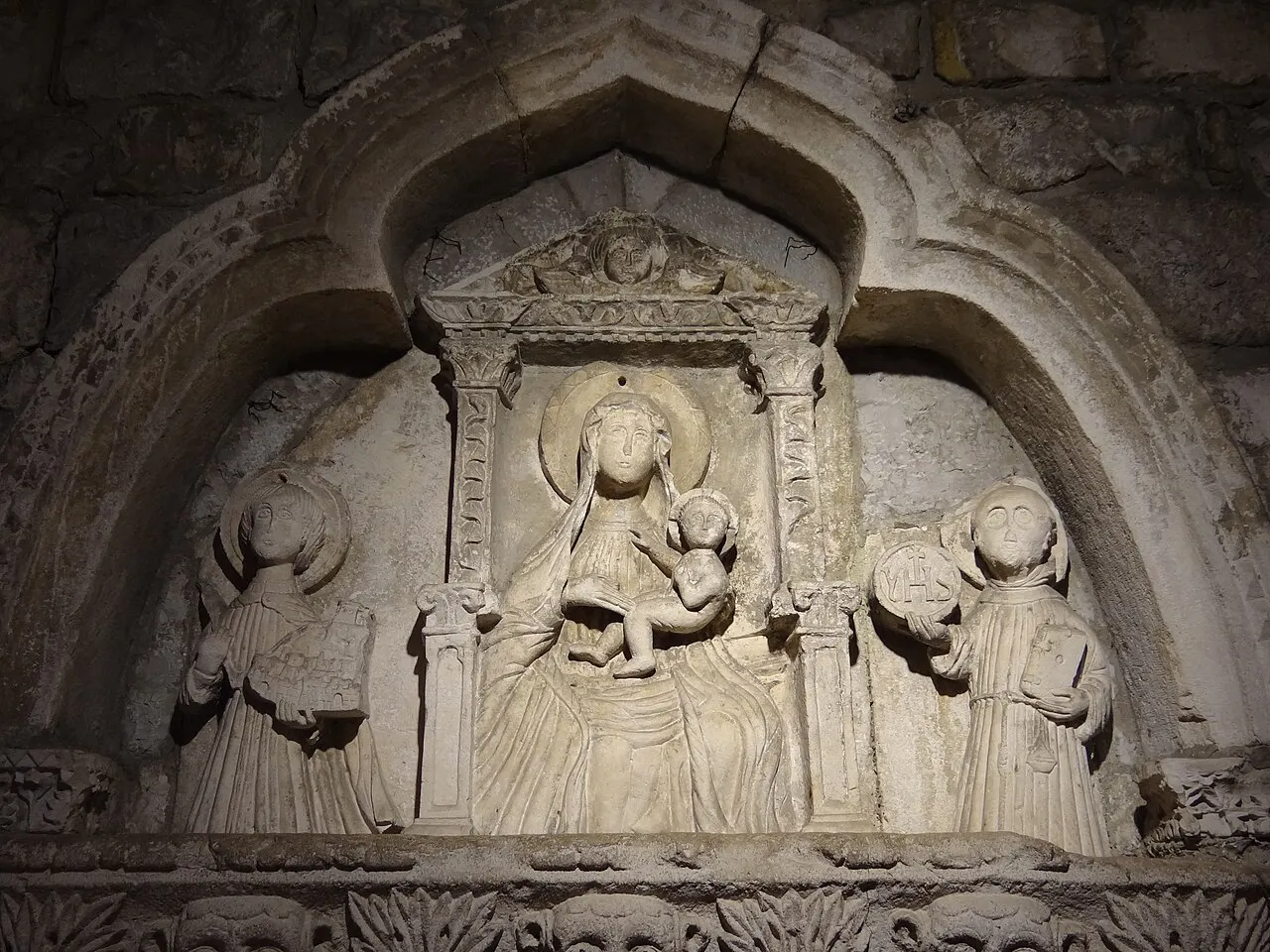
- Above the outer arch: the Madonna and Child with St Tryphon and St Bernard.
- On the inner wall: a Second World War liberation inscription from the Socialist era.
- Older stonework beneath the 1555 facade — the gate has been rebuilt over centuries.
- A small Madonna shrine just inside, often with fresh flowers.
Map pins
Map data © OpenStreetMap contributors · Tiles © OpenFreeMap
Finding the gate from the cruise port and waterfront
The Sea Gate could hardly be easier to reach. Cruise ships berth or tender right on the quay outside the western walls, so from the gangway it is only a few minutes on foot along the waterfront to the gate — no shuttle, no long transfer. Coming from the marina, the bus station or the car parks just north and east of the walls, you simply follow the line of the ramparts around to the waterfront side, where the main gate faces the bay.
Aim to pass through early on a cruise day. Because every passenger lands at roughly the same time and converges on this one main entrance, the gate and the square just inside it are at their most crowded through the late morning. Arrive at first light, or linger until the ships sail, and you can stand under the arch with the lanes nearly to yourself — which is when the threshold feels most like the doorway to another century.
- From the cruise berth: a few minutes' walk along the waterfront — no shuttle needed.
- From the marina, bus station or car parks: follow the walls round to the bay-facing side.
- Busiest mid-morning on cruise days, when everyone enters through this gate at once.
- Quietest at first light and after the ships leave.

Using the gate to plan your walk
The Sea Gate is the natural starting line for exploring the Old Town, because Kotor navigates by squares rather than street names, and this gate delivers you straight to the first one. Step through and you are in Arms Square (Trg od oružja), the largest in town, with the leaning Venetian clock tower ahead and cafés around the edges — the obvious place to get your bearings, agree a meeting point, or simply sit with a coffee and watch the town wake up.
From Arms Square, the lanes thread on to the other squares that organise the town: Flour Square, St Tryphon Square with its great twin-towered cathedral, and the smaller corners around St Luke's and St Nicholas's. A good first move is to walk from the Sea Gate to the cathedral and let yourself get lost on the way back — the Old Town is small enough that you will keep crossing your own path. When you are ready to climb, the city-wall trailhead lies toward the eastern, inland edge of the walls, a few minutes' wander from here.
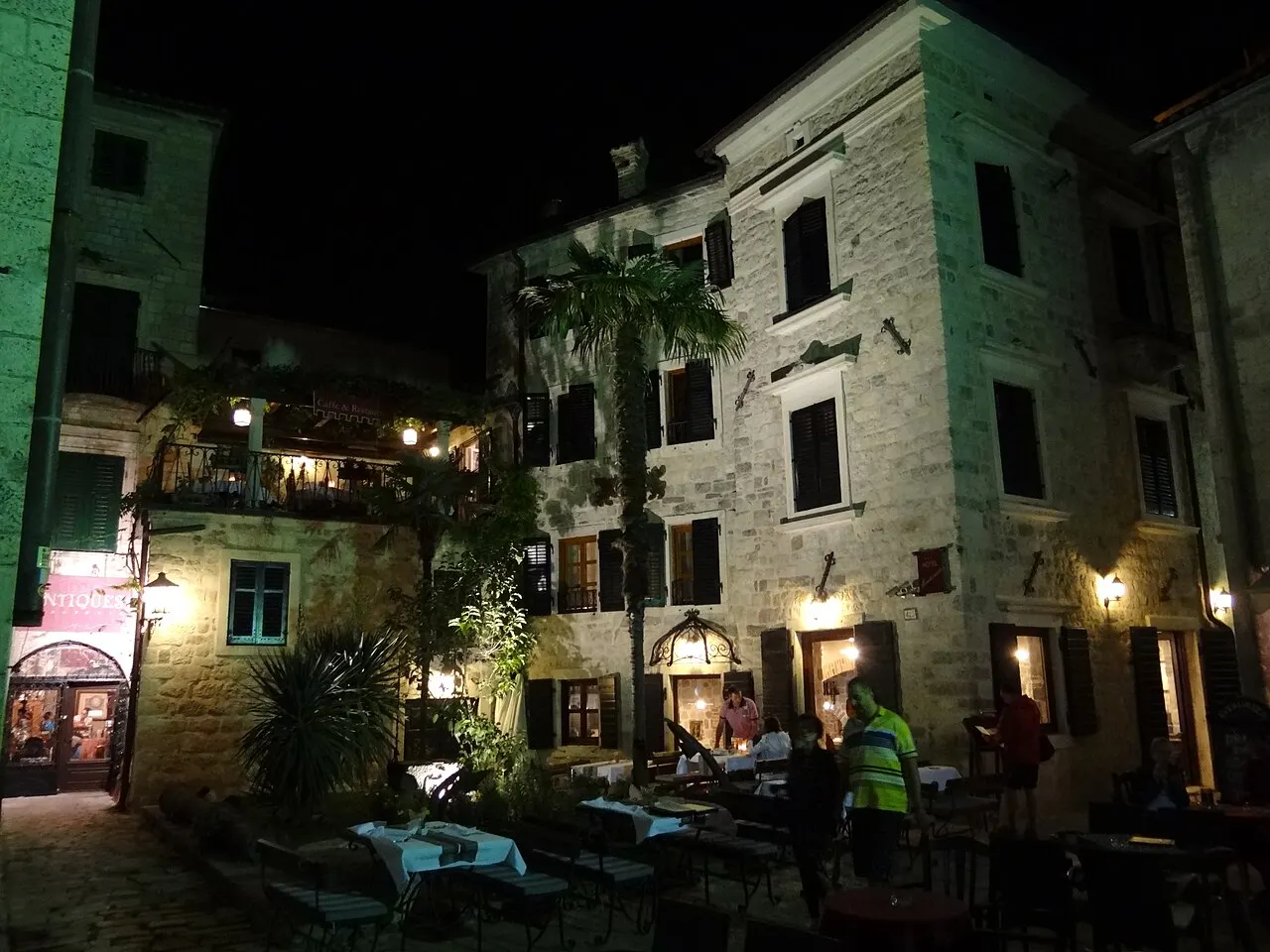
- Through the gate: Arms Square and the leaning clock tower — the orientation hub.
- Onward: Flour Square, St Tryphon Square and the cathedral.
- A good first walk: Sea Gate to the cathedral, getting lost on the way back.
- For the climb: the wall trailhead lies toward the eastern, inland edge of the walls.

Life on Arms Square, just inside
The Sea Gate is only the doorway; the room it opens into is Arms Square, and it rewards a little lingering before you plunge deeper into the lanes. The square earns its name from the days when the Venetians stored and repaired weapons here, and it has been the town's gathering place ever since. Café terraces line its edges, the leaning clock tower keeps its slightly drunken vigil, and a small stone pillar — the old pillar of shame, where wrongdoers were once exposed — stands as a reminder that this was a place of public life in every sense. Order a coffee, watch the cross-currents of arriving cruise groups and unhurried locals, and let the geography of the town settle in your head.
Practically, this is the spot to sort logistics. It is the easiest meeting point to name to a travel companion, the place where free walking tours and guides often gather, and the natural pause to check a map before you commit to a direction. Public toilets, ATMs and the first cluster of shops and bakeries are all within a few steps. If you are travelling as a group and want to split up and regroup, 'the clock tower by the Sea Gate' is the one instruction nobody in Kotor will misunderstand.
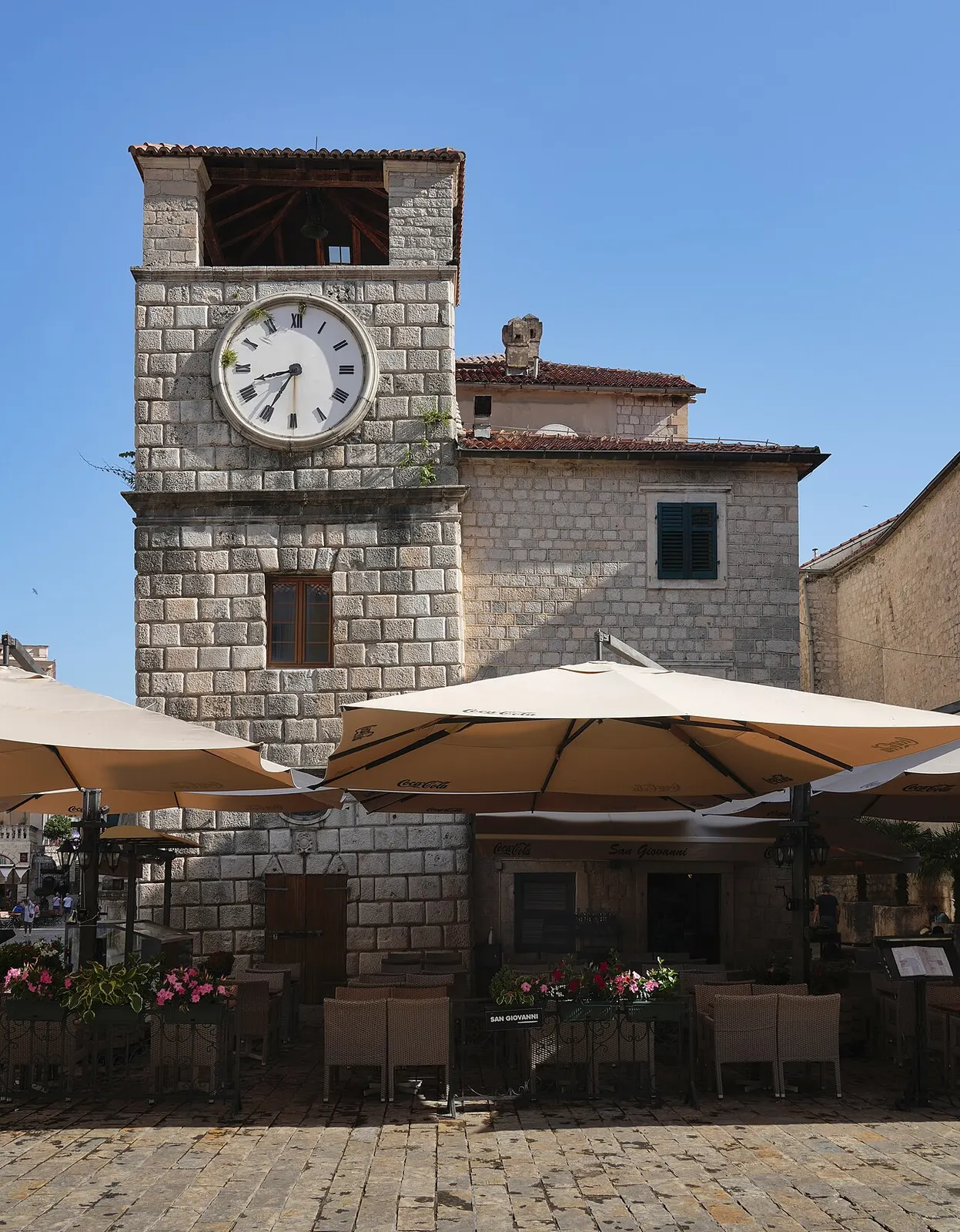
- Arms Square: named for the Venetian armoury once kept here, now ringed with café terraces.
- Landmarks: the leaning clock tower and the old stone pillar of shame.
- The obvious meeting point — easy to name, where tours and guides gather.
- Toilets, ATMs, bakeries and the first shops are all a few steps inside.

The three gates, and the gate after dark
The Sea Gate is the grandest of Kotor's three historic gates, but it helps to know the others when you plan your loops. The River Gate (Vrata od rijeke, also called the North Gate) opens to the north beside the Škurda river, near the lower wall-climb entrance and a small swimming spot in summer. The Gurdić Gate (the South Gate) is the oldest and quietest, tucked at the southern tip of the walls above the Gurdić spring. Entering by one gate and leaving by another is one of the best ways to read the shape of the Old Town and to dodge the densest crowds at the main entrance.
Come back to the Sea Gate after dark and it shows a different face. The waterfront empties, the floodlit walls glow honey-gold against the black mountain, and the arch frames a lamplit square that feels, once the day boats have gone, like a stage set. For couples it is one of the most romantic thresholds in town: cross it late, with the clock tower lit ahead and the bay still behind you, and the centuries seem to fold together. Photographers love the blue hour here, when the lights inside the gate balance the last colour in the sky.
- Sea Gate (west): the main entrance, onto Arms Square.
- River / North Gate: by the Škurda river, near the lower wall-climb entrance.
- Gurdić / South Gate: the oldest and quietest, at the southern tip of the walls.
- After dark: floodlit walls, an empty waterfront and a romantic, photogenic arch.

The Sea Gate at a glance
Use this quick card to orient yourself on arrival — the gate itself is evergreen and free to pass, but verify any volatile details (cruise-day timings, current access during events) from an official or on-the-ground source.
- What: the Sea Gate (Vrata od mora), Kotor's main western gate, built 1555.
- Where: in the bay-facing wall, on the waterfront a few minutes from the cruise berth.
- Opens onto: Arms Square and the leaning Venetian clock tower.
- Look for: the Madonna relief with St Tryphon and St Bernard; the WWII liberation inscription inside.
- Access: open and free to pass through at all hours.
- Busiest: mid-morning on cruise days; quietest at first light and after the ships leave.
- Use it as: the start of a square-to-square Old Town walk.

Kotor Old Town: A Guide to Stari Grad
How to explore Kotor's walled Old Town (Stari Grad): the gates, the squares you navigate by, St Tryphon Cathedral, the small churches, the cats, the museums and the quiet corners away from the crowds.
Read guideA Self-Guided Walk Through Kotor's Old Town
A self-guided walking route through Kotor's Old Town: the Sea Gate, Arms Square and the clock tower, St Tryphon Cathedral, St Luke's and St Nicholas, the maze of palaces and the wall-view corners — in the right order, at the right hour.
Read guide
Cruise Port to Kotor Old Town
How to get from the Kotor cruise port or tender pontoon to the Old Town: the few-minute walk, the route to the Sea Gate, accessibility on the flat-but-cobbled approach, meeting points, and the tender-day note.
Read guideMore in Old Town
5Clock Tower & Arms Square, Kotor
The Clock Tower on Arms Square is the first thing you meet inside Kotor's Sea Gate — the Old Town's natural anchor for orientation, cafés, routes and meeting up. How to use it, what to see around it, and the leaning landmark's story.
Read guideMaritime Museum of Montenegro, Kotor
Inside Kotor's Maritime Museum of Montenegro: the baroque Grgurina Palace, three floors of ships, captains' portraits, maps, weapons and Boka seafaring history — and why it is the Old Town's best rainy-day visit.
Read guide
St Luke's Church, Kotor
A guide to one of Kotor's most atmospheric small churches: St Luke's (Sveti Luka), built in 1195, famous for the rare period when it held both a Catholic and an Orthodox altar — and the quiet square it shares with St Nicholas's.
Read guide
St Nicholas's Church, Kotor
A respectful visitor guide to Kotor's main Serbian Orthodox church: St Nicholas's (Sveti Nikola), the twin-towered early-20th-century church on St Luke's Square, its glowing icons and silverwork, and how to visit.
Read guideSt Tryphon Cathedral, Kotor
How to visit Kotor's landmark Romanesque cathedral, consecrated in 1166: the twin bell towers, the treasury and the relics of St Tryphon, the art, the square, and the Old Town heritage that surrounds it.
Read guide