
Our Lady of the Rocks
A guide to Our Lady of the Rocks off Perast: the legend and the votive stones that built the islet, the 17th-century church, its icon, silver tablets and museum, the short boat across, the Fašinada ritual, and how to time and photograph a visit.

- ✓Our Lady of the Rocks (Gospa od Škrpjela) is an artificial island — built up over centuries on a reef around a rock where, by legend, sailors found an icon of the Madonna in 1452.
- ✓It sits just off Perast, a few hundred metres into the bay, paired with the natural islet of St George; the short boat across takes only a few minutes.
- ✓The blue-domed church dates from the 17th century and holds a venerated icon, around 2,500 silver and gold votive tablets, and an altar cloth a local woman embroidered over decades using her own hair.
- ✓Inside is a small museum and the bell tower; a votive painting tradition and a famous ceiling canvas tell the bay's seafaring story.
- ✓Every 22 July, the Fašinada sees Perast's men row out at dusk to drop more stones around the island — the ritual that physically created it, still performed.
- ✓Go early or late to dodge the midday tour boats, dress respectfully for an active church, and verify the small boat fare and entry donation locally as they change.
An island people built by hand
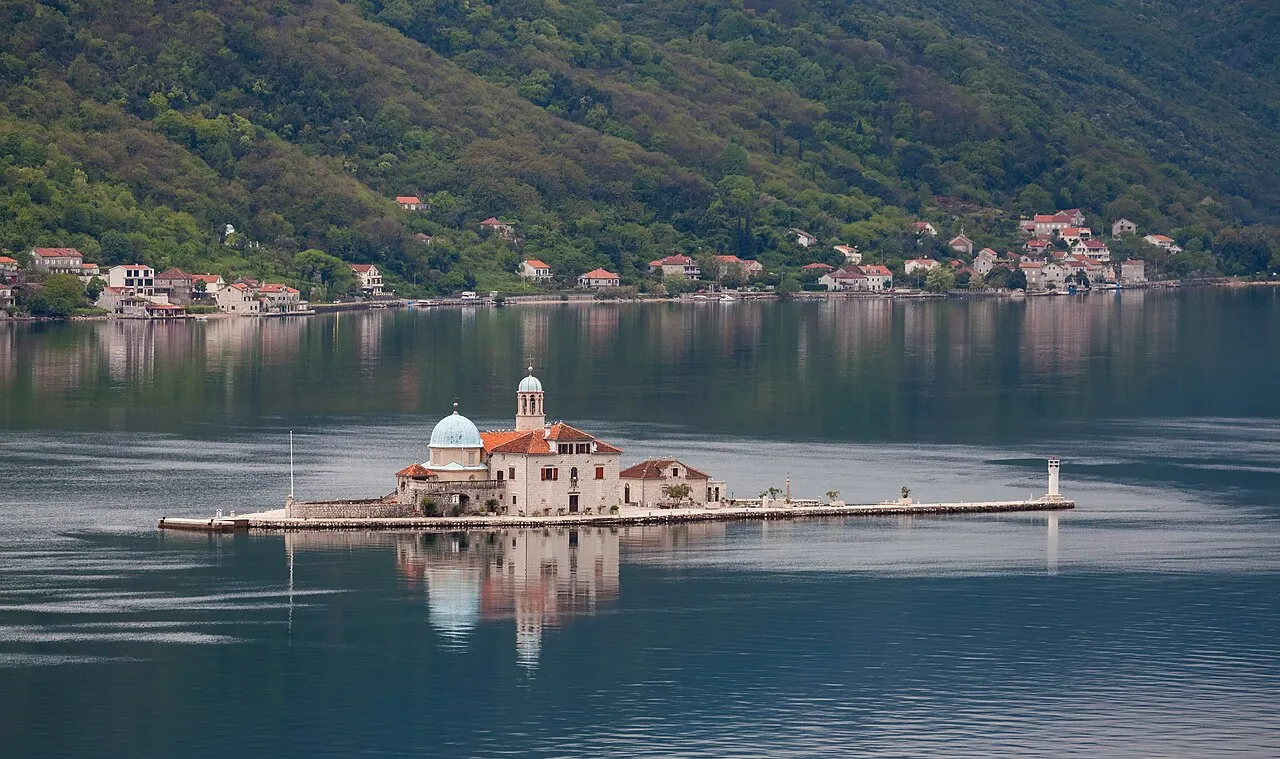
Most islands are older than the towns beside them. Our Lady of the Rocks is the opposite: a small, flat, man-made island that the people of Perast raised from the sea, stone by stone, over centuries. The story they tell begins in 1452, when two brothers — sailors — are said to have found an icon of the Madonna and Child resting on a rock barely breaking the surface of the bay. They took it ashore; it returned to the rock. Taking that as a sign, the seafarers of Perast began the slow work of building the Madonna a home where she had appeared.
The method was as practical as it was devotional. Returning captains and crews sank old, war-worn and captured ships loaded with rocks around the reef, and dropped stones from their boats, gradually enlarging the shoal into solid ground. What you stand on today is the result: a plateau of rubble and scuttled hulls, faced and flagged, just big enough for a church, a courtyard and a few cypress-shaded steps down to the water. It is one of the very few islands on the Adriatic — and a rare thing anywhere — created entirely by human hands rather than geology.

Inside the church: the icon, the silver and the hair
The church you see now is the 17th-century one, rebuilt and enlarged after earlier structures, crowned with the rounded blue dome that makes the island instantly recognisable from the Perast waterfront. Step inside and the seafaring devotion that built the place is everywhere on the walls. Above the altar is the venerated icon at the centre of the whole story, attributed by tradition to a local Baroque painter and framed by generations of offerings.
Those offerings are the island's most moving feature. Around the nave hang roughly 2,500 silver and gold votive tablets — small engraved plaques given by sailors and their families in thanks for a safe return or a prayer answered, many showing ships, storms and the perils of the open sea. They turn the church into a kind of collective diary of the bay's maritime fortunes, every plate a voyage that ended well enough for someone to come back and give thanks.
The single most extraordinary object is quieter. A local woman, Jacinta Kunić-Mijović, is said to have embroidered a large altar cloth over some twenty-five years while waiting for her seafaring love to return, working gold and silver thread together with strands of her own hair — which you can see fade from dark to grey along the cloth as the years of waiting passed. It is the kind of detail that stays with you long after the boat has taken you back to shore.
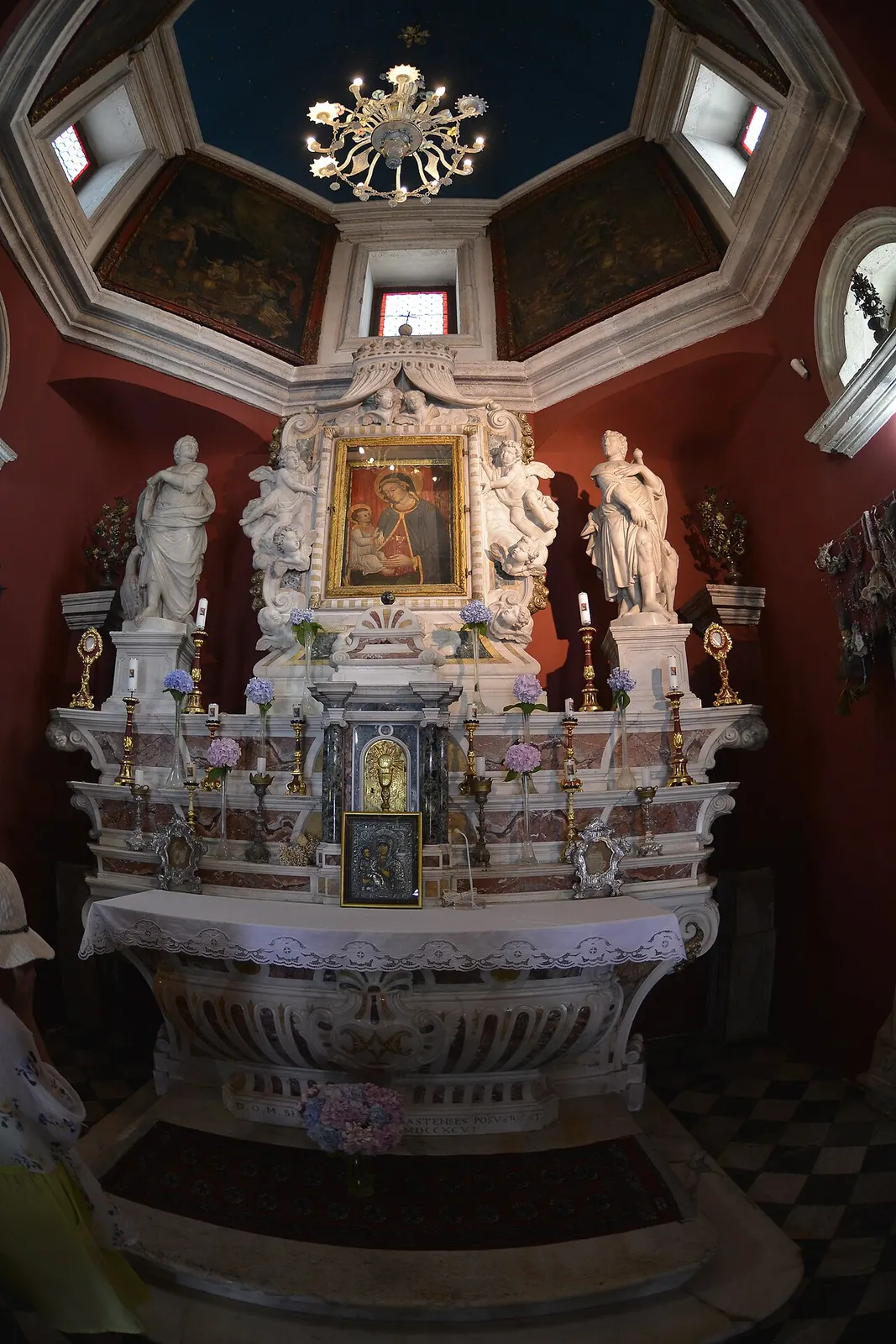
- The venerated icon of the Madonna and Child above the altar — the heart of the legend.
- Around 2,500 silver and gold votive tablets given by returning sailors and their families.
- An altar cloth embroidered over ~25 years with gold, silver and the maker's own hair.
- A large painted ceiling canvas and votive paintings telling the bay's seafaring history.

Map pins
Map data © OpenStreetMap contributors · Tiles © OpenFreeMap
The museum, the bell tower and the second island
Beside the church a small museum gathers more of the island's treasures: more votive offerings and ship models, archaeological finds raised from the seabed around the reef, religious artefacts and the gifts left by grateful seafarers across the centuries. It is compact — a short, rewarding stop rather than a long visit — and pairs naturally with a slow circuit of the courtyard and a look up at the bell tower.
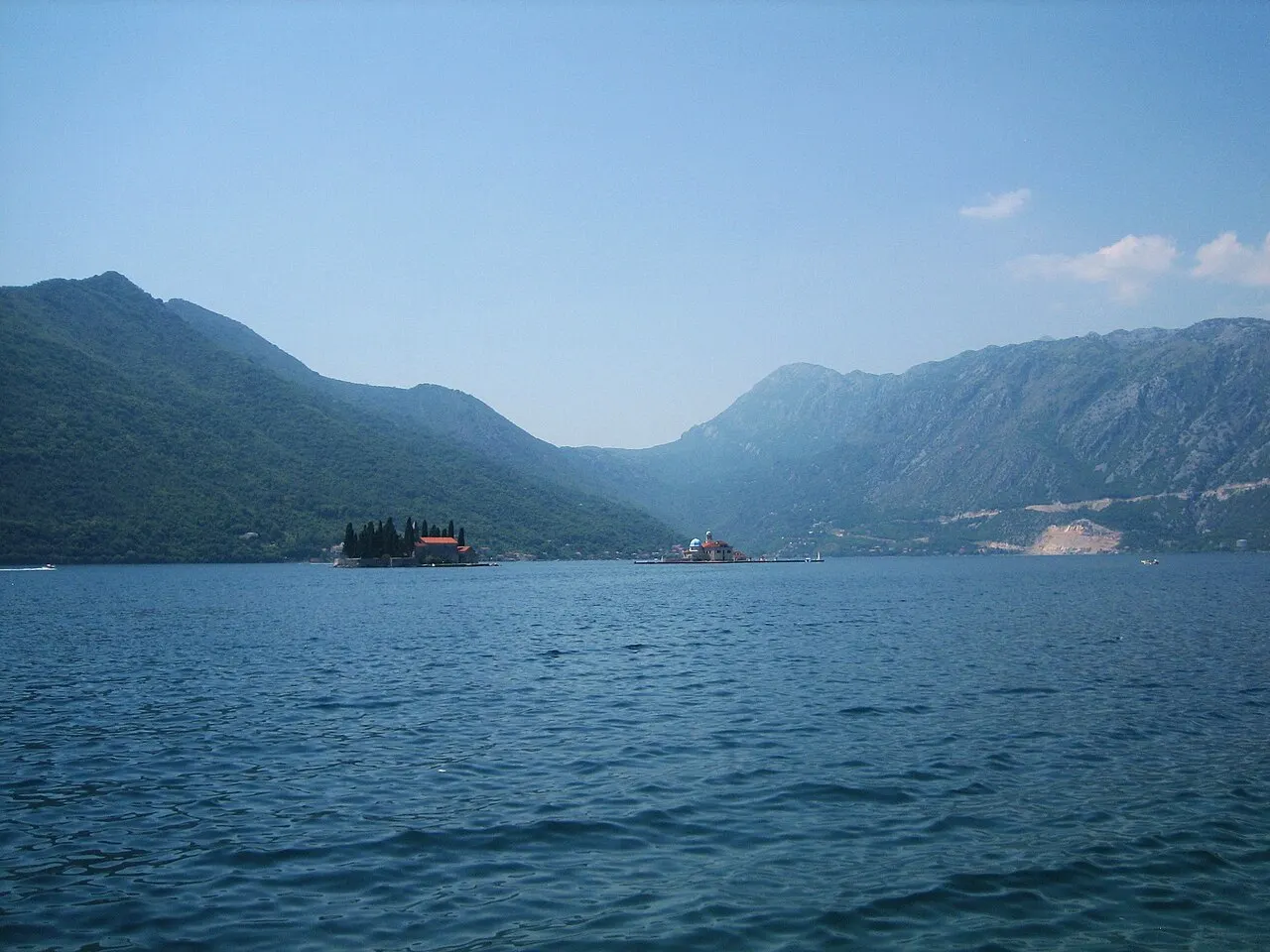
From the island you also get the bay's most-photographed double act. Our Lady of the Rocks is the man-made one, open and welcoming; its twin a short way off is St George (Sveti Đorđe), a natural islet dark with cypresses and crowned by an old Benedictine monastery. St George is not open to visitors, but seen together from the boat — or from the Perast shore — the two islands are the postcard of the whole Boka. Many people come for the photograph and leave moved by the story inside.


Getting there: the short boat from Perast
Reaching the island is half the pleasure and refreshingly simple. The launch point is the Perast waterfront, where small open boats run the few-minute hop out to Our Lady of the Rocks and back. They go frequently through the day in season, you rarely wait long, and you pay the boatman a small fare for the round trip; the church and museum then ask a modest separate entry donation. Both are inexpensive, but exact amounts move with the season — verify locally rather than trust an old figure online.
You can reach Perast itself from Kotor by car, by the regular bay bus toward Risan, by taxi, or — best of all — as part of a boat tour that takes you the whole way across the water and includes the island stop. However you arrive, allow an unhurried hour or more on the island and the boat: enough to see the church, the votives and the little museum properly, and to sit a moment in the courtyard with the bay all around you. Our dedicated guide to getting between the two towns covers every option and how long each takes.
- Boats leave from the Perast waterfront — a few-minute crossing each way, running frequently in season.
- Pay the boatman a small round-trip fare; the church/museum asks a separate modest entry donation (verify current amounts).
- Reach Perast from Kotor by car, bay bus, taxi or — best — a bay boat tour that includes the island.
- Allow an unhurried hour-plus for the crossing, the church, the votives and the museum.
The Fašinada: the ritual that still builds the island
The island was not finished centuries ago and forgotten. Every year on the evening of 22 July, Perast performs the Fašinada — a procession of decorated boats that rows out from the waterfront at dusk to drop yet more stones around Our Lady of the Rocks, reinforcing the very reef their ancestors raised. Traditionally the rowers are men of the town, and the slow line of boats moving across the darkening bay, singing as they go, is one of the most atmospheric sights in all of Montenegro.
If your visit falls near that date, it is worth planning around. The Fašinada is followed in the same season by a regatta and other festivities, and the whole bay leans into the celebration. It is also the living proof of what makes this place special: an island that people are still, quite literally, building by hand, in an unbroken line back to a legend from 1452.

Timing, etiquette and the best light
Like everywhere on the bay, Our Lady of the Rocks is busiest in the middle of the day, when group tours and cruise excursions converge on the small island at once. Go early in the morning or in the late afternoon and you will often share it with only a handful of people, with the added gift of softer light. Late in the day the bay turns gold, the blue dome glows, and Perast across the water lights up — easily the most beautiful hour to be out here.
Remember this is a living, active church, not just a photo stop. Dress modestly enough to enter — covered shoulders and knees is the safe rule, as at any Catholic church on the coast — keep your voice down inside, and be discreet with photography around worshippers. For pictures, the classic frames are the church and dome from the boat as you approach, the two islands together from the Perast shore, and the votive-lined interior. Bring a little cash for the boatman and the donation, and check the weather: in strong wind the small boats may pause, though the inner bay is usually sheltered enough to keep running when the open-sea trips are cancelled.
- Go early or late to avoid the midday tour crush — and to catch far better light.
- It's an active church: cover shoulders and knees, keep quiet inside, photograph discreetly.
- Best shots: the dome from the approaching boat; both islands from the Perast shore; the votive interior.
- Carry small cash for the boat and the entry donation; check wind before relying on the boat.
Our Lady of the Rocks at a glance
Use this card to plan the visit — but treat the volatile details (the boatman's fare, the church/museum entry donation, opening hours and the current boat schedule from Perast) as things to verify locally or from an official source, because they change with the season.
- What: a man-made islet off Perast with a 17th-century church, museum and bell tower (Gospa od Škrpjela).
- Why famous: built on votive stones and sunken ships since a 1452 icon legend; ~2,500 silver tablets; the hair-and-thread altar cloth.
- Getting there: a few-minute boat from the Perast waterfront, frequent in season.
- Costs: small boatman round-trip fare + modest church/museum donation — verify current amounts.
- Time needed: about an hour or more, unhurried.
- Best time: early morning or late afternoon for light and space; 22 July for the Fašinada ritual.
- Etiquette: active church — dress modestly, keep quiet inside, photograph respectfully.
- Paired with: St George islet (viewed, not visited) and the baroque town of Perast.
Our Lady of the Rocks FAQ
How was Our Lady of the Rocks made? It is an artificial island. After sailors reputedly found an icon of the Madonna on a rock in 1452, the people of Perast built up the reef over centuries by sinking stone-laden old ships and dropping rocks around it, creating solid ground for a church. The stone-dropping ritual, the Fašinada, is still performed every 22 July.
How do you get to Our Lady of the Rocks? Take a short boat from the Perast waterfront — the crossing is only a few minutes and boats run frequently in season. You reach Perast itself from Kotor by car, the bay bus, taxi, or a boat tour that includes the island.
How much does it cost to visit? You pay the boatman a small round-trip fare, then a separate modest donation to enter the church and museum. Both are inexpensive, but the exact amounts change — confirm them locally rather than relying on old quotes.
Can you go inside the church? Yes. The church and its small museum are open to visitors; it is the natural reason to make the trip. Because it is an active church, dress modestly (covered shoulders and knees), keep quiet inside, and be discreet with photography.
Is St George island also open to visit? No. St George (Sveti Đorđe), the second islet beside Our Lady of the Rocks, is a natural island with a Benedictine monastery that is closed to visitors. You admire it from the boat or the Perast shore rather than landing on it.
What is the best time to go? Early morning or late afternoon, to avoid the midday tour boats and catch softer, golden light. If you can time it for the evening of 22 July, the Fašinada boat procession is unforgettable.
How long should I spend there? Allow about an hour or more for the crossing, the church, the votive tablets and the little museum, plus a pause in the courtyard — it rewards an unhurried visit rather than a quick dash.

Perast
The baroque captains' town on the Bay of Kotor: its seafaring palaces and churches, the waterfront walk, St Nicholas and its bell tower, the boats to Our Lady of the Rocks, the Fašinada, and how to arrive, stay and eat.
Read guide
Kotor to Perast by Boat
Every way to get from Kotor to Perast and Our Lady of the Rocks: boat tours (shared and private), the bay bus, taxi and driving — with steps, rough durations and the catch that there is no scheduled passenger ferry.
Read guide
Fašinada in Perast
A guide to the Fašinada — Perast's centuries-old tradition, held every 22 July, when at dusk a procession of boats rows out to Our Lady of the Rocks and drops stones to reinforce the island — with its legend, timing and how to watch respectfully.
Read guideMore in Bay of Kotor
6
Bay of Kotor Boat Tours
Compare the kinds of boat trip on the Bay of Kotor: shared group tours, fast speedboat trips, private charters, the Perast and Our Lady of the Rocks classic, the Blue Cave route, and sunset cruises — what each suits, rough durations and the weather caveat.
Read guide
Best Swimming Spots in the Bay of Kotor
The best places to swim in the Bay of Kotor, compared by access, water, shade, families, boat traffic and view: the Dobrota platforms, the Muo and Prčanj rocks, the quiet Stoliv, Orahovac and Ljuta coves, and the clear-water Luštica beaches out toward the open sea.
Read guide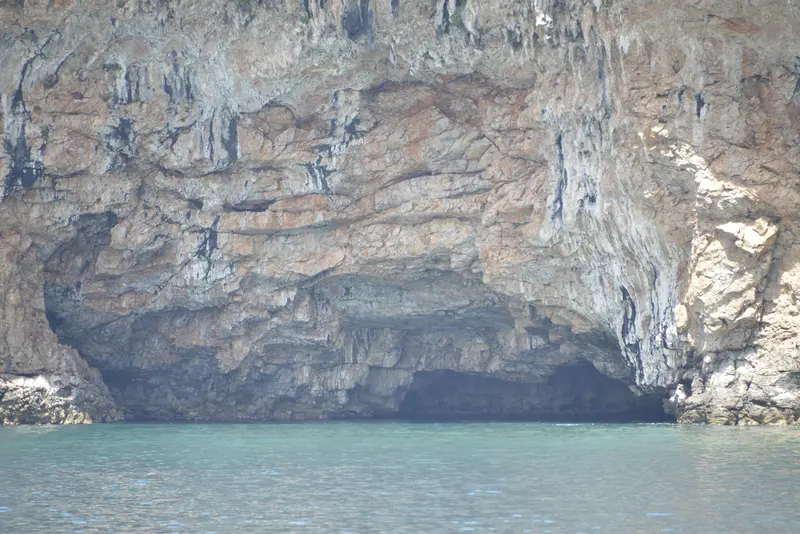
Blue Cave Montenegro
Is the Blue Cave (Plava Špilja) worth it from Kotor? What it is and why the water glows, where it sits near the bay mouth, how trips reach it, the sea-condition and timing realities, swimming inside, the crowds, and the honest verdict with alternatives.
Read guide
Kayaking & SUP in Kotor Bay
Where paddling works in the Bay of Kotor: the sheltered inner bay off Dobrota, Muo and Prčanj, the beginner-friendly routes, the all-important morning-wind safety rule, what to rent and which guided trips to join, and who kayaking and stand-up paddleboarding suit.
Read guide
Kotor Sunset Cruise Guide
When to book a sunset cruise in Kotor and what route to choose: why the bay is at its most beautiful at golden hour, the Perast run versus the open-bay loop, group boats versus going private, and how the high mountains change the sunset itself.
Read guide
Luštica Peninsula
A guide to the Luštica peninsula at the mouth of the Bay of Kotor: its clear open-sea beaches and coves like Žanjice, Mirište and Rose, the Blue Cave, the quiet hill villages and olive groves, the drive-versus-boat decision, and when it's worth leaving the inner bay.
Read guide